
Chimney repair & leadwork — Merseyside
Chimneys and lead flashings are the two hardest parts of any roof to get right. They're also the bits that fail first. A Victorian brick chimney exposed to 130 years of Liverpool weather will have lost its pointing, shifted its flaunching, and corroded its flashings long before the rest of the roof needs attention. Liverpool Roofs handles the full range of chimney and lead work — from a single pot re-bedding, through full chimney repoints, rebuilds, and stack removals, to complete lead valley and dormer re-linings. All leadwork is carried to BS EN 12588 standards using rolled Code 4 and Code 5 lead from UK mills.
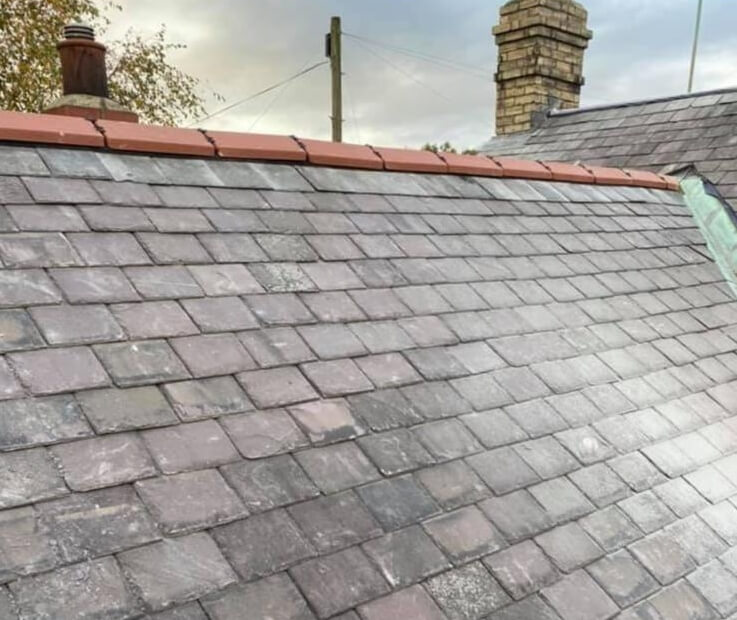
Common chimney problems we fix
- Failed pointing — old lime mortar eroded by weather, leaving open joints. Water penetrates, then freezes, then prises bricks apart. Usually obvious as eroded grooves between bricks.
- Cracked flaunching — the sloped mortar bed that holds the chimney pots. When it cracks, water gets inside the stack and eventually blows back out through internal walls as damp patches.
- Loose chimney pots — commonly caused by failed flaunching. In a high wind a loose pot can come off and cause serious damage below — we treat these as priority jobs.
- Leaning stack — usually down to sulphate attack where coal was burned in the original flue. The lee side of the stack gets damper, grows softer, and the whole thing tilts. Beyond a certain lean it's a demolition-and-rebuild job rather than a repair.
- Missing or corroded lead flashings — front apron, side soakers, back gutter tray. Particularly the back gutter behind a chimney on a pitched roof — it's the commonest source of ceiling leaks.
- Failed chimney cap — GRP or metal caps crack, crown flashings split. For redundant chimneys (fireplace removed, flue no longer in use), we fit capped ventilator caps that stop water in but allow air through so the flue doesn't sweat.


Chimney repointing
We repoint chimneys in one of two mortar mixes depending on what's already there:
- Lime mortar (NHL 3.5 or hot-mixed lime putty) for Victorian and Edwardian chimneys on pre-1919 housing. Lime flexes with the brickwork and lets moisture evaporate out — using cement on an old lime-bedded chimney traps water and accelerates brick failure.
- Cement mortar (1:1:6 or pre-mixed polymer mortar) for post-war chimneys that were originally laid in cement.
We rake out the joints to a minimum 20mm depth, wet the brickwork, and point in. Expect 1–2 days for a single chimney, 2–3 days for a shared party-wall stack, plus scaffold time either side.
Chimney rebuilds
Once a chimney is too far gone to repoint (leaning, cracked through the stack, bricks spalling) the only real answer is to take it down and rebuild. We take photographs and measurements before demolition so that the rebuilt stack is an exact match for the original — same brick type (we source reclaimed Ruabon or Accrington where needed), same pot style, same courses, same corbelling. A 600mm-above-ridge rebuild on a terraced Liverpool chimney is typically 3–5 days including scaffold.
Chimney removal
Many houses we work on have disused chimneys — central heating replaced open fires decades ago, and the stack is redundant, ugly, and a maintenance headache. Options:
- Full removal down to ridge — we drop the stack, infill the chase left in the ridge, cap off the internal flue at ceiling level, and re-slate/re-tile the gap so there's no evidence it was ever there. Building Regs apply — we handle the notification. Typical cost: £1,400–£2,400.
- Removal down to loft — stack comes off externally only; internal breast stays. Cheaper and quicker; useful if you want to reclaim loft space later without disturbing the rooms below.
- Cap & vent — cheapest option if you're not ready to lose the stack entirely. Cap fitted, pot vented, flaunching renewed. Good for 20+ years.

Leadwork — to BS EN 12588
Lead is the gold standard for flashings and valleys on UK roofs. Installed properly, lead lasts 80–100 years. Installed badly — or worse, replaced with flashband or mastic — and you're booking a repeat leak within three years. All our leadwork is:
- Rolled milled lead sheet to BS EN 12588, Code 4 or Code 5 depending on application.
- Cut, welted and dressed on-site. No single run longer than 1.5m (thermal expansion rule).
- Bossed at corners — we don't use lead corner pieces or silicone.
- Wedged, pointed in lime-based mortar or lead mastic, not sand-cement.
- Patinated oil applied at completion to prevent carbonate staining on the wall below.
Lead valleys
Valley gutters on traditional slate and tile roofs should be lead-lined, 450mm–600mm wide depending on catchment area. We replace rotten or corroded valleys to original specification — no plastic "GRP valley trough" on period properties unless lead theft is an active concern in the postcode.
Lead dormer tops and cheeks
Dormer tops above bay windows, porches, and first-floor extensions are a classic leak point. We strip the old covering, fit new boarding where needed, and re-lead in Code 5 with welted drips and expansion joints at the correct centres. Typical bay-window roof dormer: £850–£1,300.
Lead theft insurance
Lead theft is still a reality in some areas. We can spray your leadwork with SmartWater and register it to your postcode — most insurers offer a discount on premiums for protected lead, and recovered stolen lead can be traced back to the property.